

What has been is what will be, and what has been done is what will be done, and there is nothing new under the sun. There is a thing of which [someone] will say, "See this, it is new." It has already been for ages which were before us. Ecclesiastes 1:9-10
Since the college basketball transfer portal closed, I have seen an inundation of reports noting men’s basketball roster spends surpassing $10,000,000 for the 2026 season. After asking some GMs around the space, Dan Hurley’s $14,000,000 mark appears to be an accurate reflection of the new gold standard for fielding a competitive roster. How did college basketball spending get to this level?
College athletics departments were supposed to operate under a revenue-sharing cap of $21.3 million this upcoming season, with roughly 20% earmarked for men’s basketball. That was, at least, the vision plaintiff attorneys sold college sports leaders when negotiating the House v. NCAA settlement, the agreement that has since ushered in a more professionalized college sports landscape.
In theory, that framework should have capped elite men’s basketball rosters at roughly $5,000,000 in annual spending. Instead, we now have more than a handful of star players whose single-season payouts next year will surpass what sports leaders intended Duke or Kansas’ entire team budget to be.
This result, however, should not come as a much of a surprise. The House settlement was the NCAA’s costly attempt to create a proxy-CBA governing a sports league rapidly moving away from any remaining pretense of amateurism. Part of that governance structure was an auditing apparatus, the College Sports Commission (CSC), designed to invalidate pay-for-play NIL deals masquerading as legitimate endorsements.
The transition period before the settlement’s enforcement mechanisms fully took effect effectively supercharged the market. Schools front-loaded compensation packages to secure players before meaningful cap enforcement existed, resetting market expectations far beyond what the proposed revenue-sharing structure was realistically designed to sustain.
This upcoming season, rather than dialing spending back toward the intended cap structure, schools looking to maintain their advantages and secure top players instead searched for increasingly transparent mechanisms to route compensation beyond it.
Last week, the CSC notched what it called a significant win, with an arbitrator ruling in its favor against 18 Nebraska football players whose deals with Playfly, the school’s own multimedia rights partner, were found to lack valid business purpose and to be improperly warehousing NIL rights. CSC CEO Bryan Seeley declared the system was “working as intended.”
The ink was barely dry when Seeley told reporters in the same breath that the ruling should not be considered a precedent. Meanwhile, down in Amelia Island, college sports leaders were wrapping up the ACC’s spring meetings at the Ritz-Carlton.
Among the discussions was a proposal being floated among Power Four commissioners to grant schools a one-year amnesty for blowing past the very cap the CSC had just finished defending. Ohio State AD Ross Bjork told Sports Business Journal the entire governance structure needed to be “rethought, reimagined.” Notre Dame AD Pete Bevacqua was more direct: “The cap is not operating the way it’s intended. The cap needs to be looked at, and I think cap people agree it needs to be raised.”
The CSC won on Monday. By Wednesday, the people it governs were in Florida negotiating the terms of their own forgiveness.
Seeley was direct in response. Pushing back against complaints from athletic directors, he reminded them that his office was enforcing regulations the universities had drafted themselves. “It is totally fine with us if the rules end up changing if there is consensus to change those rules,” Seeley said. “But until that happens, we're going to enforce the rules as written and that's what we were told to do.”
The point of this piece is not to bemoan the prisoner’s dilemma that has pushed nearly every power conference school to subvert rules they once demanded during the unchecked booster spending of early NIL. It is to recognize that what we are witnessing is not new.
It is, in fact, soberingly familiar to anyone who has studied the history of the NCAA. What we are witnessing is the same cycle, with the same architecture and nearly the same outcome, that has played out every single time a governing body has attempted to impose centralized order on amateurism restrictions in college athletics.
Amateurism Was Always Negotiated
When people talk about the degradation of amateur ideals in college athletics, it makes me laugh. The best response to anyone lamenting the death of amateurism is to ask them a simple question: when, exactly, do you believe it died?
Many will likely say 2021. After all, that was the inception of NIL, the upending of restrictions that has turned some of our most prominent athletes into teenage millionaires before they have played a single college game. A reasonable answer, if an incomplete one.
If you asked me, I might point to the scholarship era of the late 1950s, when the NCAA walked back its moratorium of awarding aid on the basis of athletic merit. Still, others might gesture toward the explosion of television money in the 1980s, or the arms race in coaching salaries that followed. At the end of the day, everyone has a moment they can point to.
That disagreement is in and of itself the real tell. Amateurism in college sports was never a stable condition that was subsequently corrupted. It was always a negotiation, a line drawn in the sand, then redrawn, then moved again, each time adjusting to what the market demanded and what governing bodies could credibly claim to prohibit. To mourn its loss is to mourn something that existed primarily as a legal fiction and rhetorical shield rather than a genuine principled position. If you are not okay with athletes earning revenue share, but are okay with them earning an athletic scholarship, the true tenets of amateurism do not support your position.
Understanding why requires going back further than most people often go.
Amateurism is not an American invention. It is a holdover of aristocratic British ideology, designed not to protect sport but to protect a class of people who played it. The distinction between the amateur and the professional was, at its origin, a distinction between those who played sports for leisure and those who played sports for money. The rules of amateurism were written to keep the latter out of competition with the former, to ensure that the people who rowed at Henley or played cricket at Lord’s did not have to share a field with someone for whom the outcome of a match was an economic matter.
Golf illustrates this tradition quite well. For much of the sport’s early history, the professional was a tradesman. He gave lessons, repaired equipment, and was employed by the club. His work was golf. The gentleman amateur, by contrast, played the game for its own sake, unencumbered by the need to earn a living from it. Bobby Jones is the obvious example. Widely considered the greatest golfer of his era and the last winner of the calendar Grand Slam in 1930, albeit a modified one by modern standards, Jones never accepted prize money and retired from competitive golf at twenty-eight to return to his law practice.
The distinction that Bobby Jones embodied did not survive the sport’s commercial ascent. As television money poured into golf through the 1950s and 1960s and tournament purses grew accordingly, the tension between club professionals and touring professionals became impossible to contain within a single organization. In 1968, Jack Nicklaus and a group of the sport’s elite tournament players formally broke from the PGA of America to create what would eventually become the PGA Tour. Palmer himself was characteristically blunt about the reason: “As crass as it sounds, the issue was really money — more precisely, television money.”
By then the amateur and the teaching professional occupied entirely different worlds. The teaching pro ran clinics, repaired equipment, and managed club operations. The elite touring professional was a television commodity competing for purses that only continued to grow in size. The amateur distinction had quietly shifted too. It no longer described a gentleman of leisure choosing sport over commerce. It described those who were too young or not yet skilled enough from turning professional. The romantic ideal of Bobby Jones, the brilliant amateur who walked away from prize money on principle, had become a relic not because anyone abolished it, but because the commercial gravity of the sport had made it structurally impossible to sustain.
The Olympic movement reinforced this ideology on a global scale. Until relatively recently, the Games maintained strict standards of amateurism under the same pretenses, famously stripping Jim Thorpe of his medals following the 1912 Stockholm Games on the grounds that he had previously been paid to play minor league baseball. The most decorated athlete at those Games was rendered retroactively ineligible because he had once been paid to play a sport. Only in 2022 did the IOC reinstate Thorpe as the sole undisputed winner of that year's decathlon and pentathlon, almost 70 years postmortem.
Americans then held, and still hold, a well-documented disdain for British aristocratic pretension. Yet, in the hallowed halls of the oldest and most prestigious American universities, that disdain did not particularly apply because those institutions were themselves built on exactly that kind of exclusivity. The Ivy League did not import amateurism reluctantly. The ideology traveled well in those corridors because the corridors themselves were built for it. College in the United States was not, for most of its history, an accessible institution.
It would be partially incomplete to say amateurism was a foreign concept grafted onto American higher education. It was also a natural expression of the social order elite American universities were designed to reproduce in the late nineteenth century, precisely as collegiate athletics began requiring more formal governance structures.
The first intercollegiate American football contest was played between Rutgers and Princeton in 1869. Professional football did not formally organize until 1920, more than fifty years later, when the NFL was founded in Canton, Ohio, initially as a loose collection of Midwestern industrial town teams. For decades it trailed college football in popularity, cultural prestige, and institutional legitimacy.
The sport that would eventually become the most commercially dominant entertainment product in American history was codified at elite northeastern universities as a direct expression of the gentleman amateur ideal.
No one articulated that social order more plainly than Walter Camp, the architect of the modern game: introducing the line of scrimmage, the system of downs, and the eleven-man team through a series of rules conventions held among Ivy League institutions in the 1880s. Writing at the turn of the twentieth century, Camp declared amateurism as a foundational principle of the game: “A Gentleman never competes for money.” Camp was of direct English colonial descent, his earliest known ancestor having arrived from Essex, England in 1630 and settled in Connecticut. He was a member of Skull and Bones, married into the family of a prominent Yale professor, and spent his entire life embedded in the most exclusive institutional corridors in America.
The irony of Walter Camp’s principled public statements is that he was reportedly connected to a Yale recruiting fund that exceeded $100,000 in 1906. In today’s dollars, that figure approaches $4 million depending on the inflation metric used, and by some economic measurements the value would be substantially higher. Yet even those resources were not enough to consistently surpass programs like University of Michigan, Princeton University, University of Pennsylvania, and Harvard University, all of whom enjoyed greater football success during portions of the era.
Camp also helped bring Irish immigrant laborer James Hogan to Yale, where Hogan enrolled as a 25-year-old freshman and eventually earned All-American honors three times. While at Yale, Hogan reportedly lived far beyond the means of an ordinary student and worked as the functional equivalent of a brand ambassador for the American Tobacco Company, earning commissions on cigarette sales throughout New Haven.
Although the staggering number of deaths and catastrophic injuries in football served as the primary catalyst for reform, the broader culture surrounding early college football had also become deeply troubled. Recruiting inducements, sham amateurism, eligibility abuses, and under-the-table compensation had become pervasive enough that President Theodore Roosevelt intervened publicly and pushed university leaders toward structural reform.
In 1905, following a season that produced at least 19 fatalities and more than 100 serious injuries, Roosevelt convened representatives from major football powers at the White House to address the sport as a matter of national concern. The meetings ultimately helped spur the creation of the Intercollegiate Athletic Association of the United States (IAAUS), the organization that would later become the National Collegiate Athletic Association in 1910.
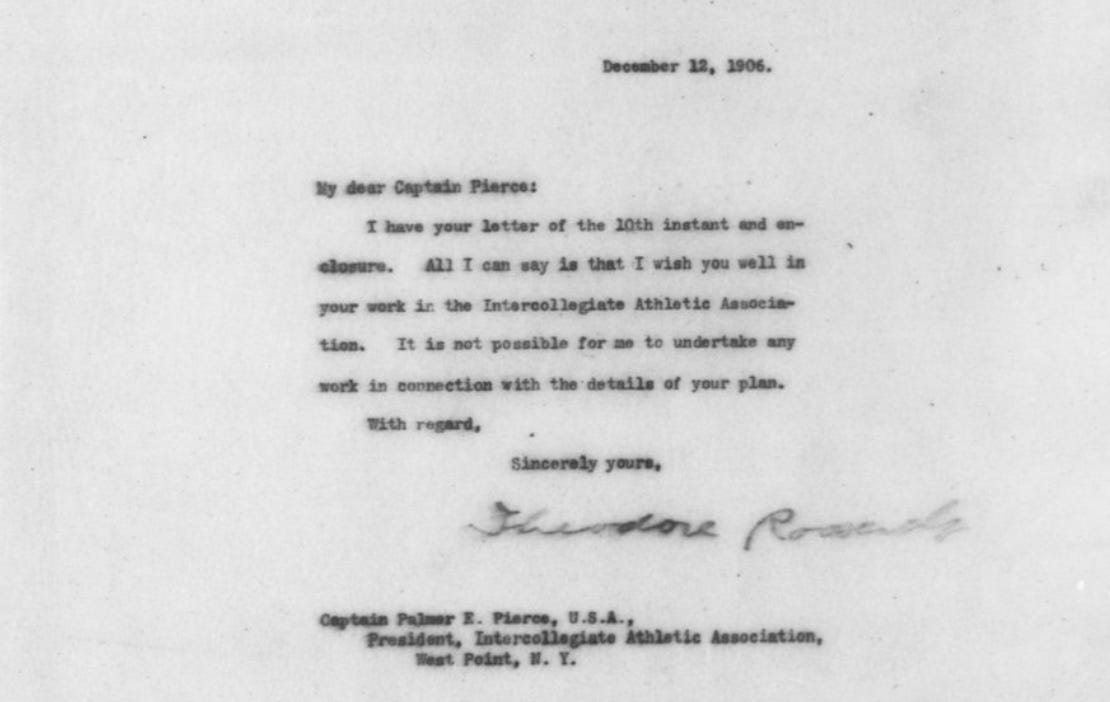
At the 1906 IAAUS convention, several foundational principles for the future of college athletics were codified. On paper, many of those principles have survived for more than a century, even if they have been repeatedly challenged, circumvented, and redefined in practice:
Schools, alumni, and boosters were prohibited from recruiting athletes through payments, benefits, or special treatment tied to athletic ability.
Colleges could not “poach” talented prep-school athletes by aggressively steering them toward a particular institution because of sports.
Only true students in good academic standing could compete in college athletics.
Professional athletes, or anyone who had accepted money connected to athletic performance, were barred from college competition.
Athletes could not receive compensation for playing, coaching, training, or competing in sports contests involving prize money or gate receipts.
In many respects, there is something intellectually honest about the Ivy League’s continued commitment to a more traditional, albeit imperfect, conception of amateur athletics and its longstanding refusal to adopt athletic scholarships. If one wants to see a version of college sports still tethered to the original principles underlying amateurism, one largely has to look there.
The Ivy League has remained more willing than its major-conference counterparts to subordinate athletic ambition to other institutional priorities, however self-important those priorities may sometimes appear. Amateurism within those institutions was never merely an athletic principle. It was part of a larger educational and social philosophy that viewed athletics as subordinate to academic and cultural refinement rather than as a commercial enterprise deserving institutional prioritization.
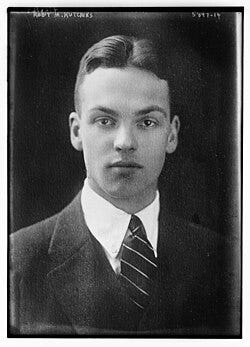
The University of Chicago’s departure from major college football illustrates this divide particularly well. Chicago disbanded its football program in 1939 and formally withdrew from the Big Ten in 1946 under similar philosophical pretenses. Under president Robert M. Hutchins, the university embraced stricter academic standards and increasingly rejected the growing commercialization of intercollegiate athletics at precisely the moment peer institutions were moving in the opposite direction.
As major programs aggressively pursued athletic prestige through increasingly flexible admissions practices, subsidized aid, and quiet recruiting inducements, Chicago chose institutional restraint over competitive escalation. That decision came at an obvious athletic cost, but it was at least ideologically coherent.
Most of college sports, however, did not want to become the Ivy League or the University of Chicago. Schools wanted the visibility, revenue, cultural relevance, and communal identity that accompanied major athletic success without embracing the exclusivity and institutional restraint that historically underpinned the amateur model itself. Chicago and the Ivy League are not relics. The amateur ideal does not collapse on its own: it collapses under commercial pressure that those institutions, for various reasons, never fully absorbed.
It would be incomplete to say that schools defected from amateurism rules merely in pursuit of competitive advantages, though they certainly did. It was that many institutions increasingly no longer believed the restrictions themselves were particularly legitimate. As college sports evolved into a commercial entertainment industry generating enormous economic value, the old restraints began to appear less like principled safeguards and more like arbitrary limitations selectively enforced against athletes.
At every stage, the rules became harder to collectively justify and even harder to collectively maintain. Players were supposed to be admitted like ordinary students. Yet schools increasingly stretched admissions standards for elite athletes. Players were not supposed to receive athletic aid. Then scholarships became necessary to remain competitive. Players could not be paid directly. Compensation instead flowed indirectly through jobs, slush funds, boosters, and eventually NIL collectives.
Each successive compromise weakened the legitimacy of the restraints that remained. As both our nation and our nation’s universities culture and environment changed, these long standing restrictions created in the ideals of a bygone era of gentleman amateurism seemed more and more distant and less worthy of stronghanded enofrcment.
The amateur distinction is what separated college sports from their more rugged and upstart peers in the professional baseball and football leagues beginning to emerge in the late nineteenth and early twentieth centuries. Amateurism was a lever of class, a mechanism of socioeconomic segregation dressed in the language of virtue and institutional purity.
As American institutions became less tethered to aristocratic British ideals, and as professional sports emerged as the dominant form of mass entertainment, the moral authority underlying amateurism began to erode.
Once enough institutions simultaneously stop believing in the underlying principles of amateurism while still desperately wanting to win, enforcement itself begins to collapse. Punishing competitors for conduct that mirrors your own becomes politically difficult, commercially inconvenient, and institutionally unstable.
The more honest answer to when amateurism died is that it never really lived, not as a genuine principle, anyway. What lived was the enforcement of it, selectively, against whoever was convenient, by institutions that were themselves violating its spirit in a hundred different ways. The story of that selective enforcement is, in many respects, the entire history of the NCAA.
The truth is that the death knell of amateurism as a governing principle was not struck by athletes in 2021. It was struck decades earlier by the institutions themselves.
When the Rules Stopped Mattering
As seen with Yale, the rise of major college football in the early twentieth century brought with it many of the same market distortions college sports grapples with today: recruiting inducements, no-show jobs, slush funds, and athletes quietly funneled compensation through boosters and alumni networks. Universities routinely found ways to place athletes on payrolls for work they never meaningfully performed, while “ringers” with little genuine academic connection to the institution appeared on campus to bolster athletic teams.
Strip away the terminology and the similarities to the modern era become difficult to ignore. The no-show job becomes the NIL collective deal. The alumni slush fund becomes the booster-backed marketing arrangement. The “ringer” becomes the older transfer or former professional athlete arriving with compensation expectations far beyond what college sports leaders publicly claim the system was designed to sustain.
In 1929, the Big Ten moved to expel the University of Iowa after revelations that alumni organizations had created slush funds paying football players “upkeep” stipends and tuition reimbursements in direct violation of the conference’s amateurism rules. Additional reports alleged that money generated through yearbook operations and outside alumni commitments had been funneled toward star athletes through monthly payments and disguised financial support.
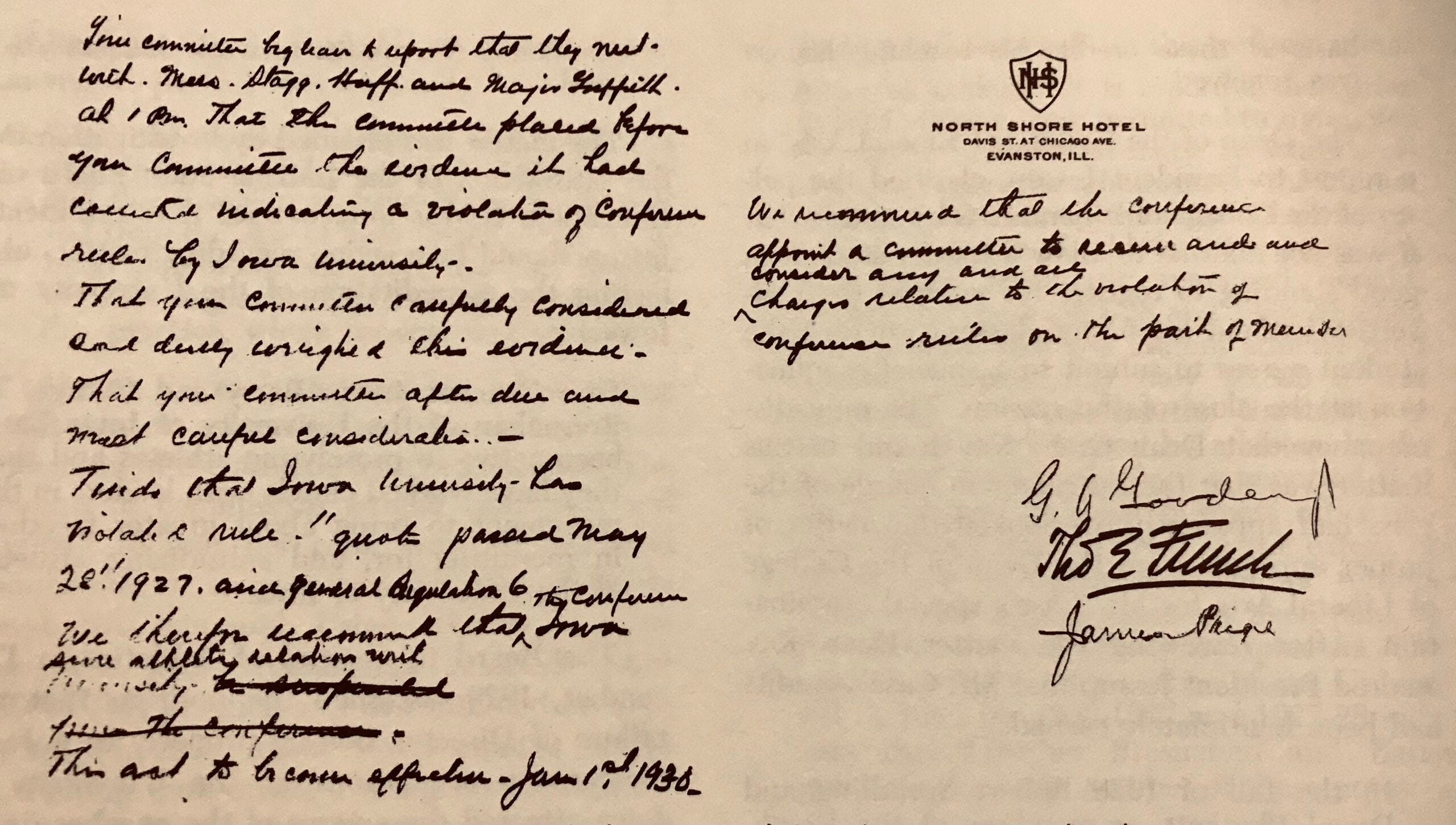
Yet Iowa’s exile did not last long. The university was reinstated in 1930 for a simple reason: the same practices were occurring throughout the conference itself. Investigations from the Carnegie Report on College Athletics revealed that seven of the remaining nine Big Ten institutions had engaged in similar conduct.
The interwar years had already transformed college football into a major source of institutional prestige and public attention. Universities poured money into enormous stadium construction projects, gate revenues ballooned, alumni involvement intensified, and football increasingly became a centerpiece of campus identity at large state universities.
The postwar era, however, dramatically intensified the commercial pressures surrounding the sport and fundamentally challenged the ability of college athletics to function without centralized governance. The GI Bill flooded universities with returning veterans and transformed higher education itself into a far larger and more publicly visible institution than it had previously been.
By 1947, veterans comprised nearly half of all college enrollments in the United States. Campuses suddenly filled with older students returning from military service, many of whom were more physically mature and experienced than traditional college athletes. Football programs that had been interrupted or depleted during the war aggressively pursued talent as the financial, political, and institutional value of winning continued to grow.
The undefeated 1946 Bates football team, for example, was almost exclusively composed of veterans, with many seniors aged between twenty-four and twenty-six years old.
In many respects, the destabilization of the postwar era bears resemblance to the modern post-COVID landscape of college athletics. Temporary exceptions introduced during periods of institutional crisis have a tendency to permanently alter expectations surrounding what rules are truly necessary and which are merely traditions waiting to be discarded.
During the pandemic, athletes were granted additional years of eligibility, transfer restrictions softened dramatically, and emergency waivers normalized a level of mobility and flexibility the NCAA had spent decades resisting. NIL compensation arrived shortly thereafter, accelerating a broader institutional realization that many of the sport’s supposedly rigid restrictions were, in practice, far more negotiable than previously advertised.
After World War II, large state universities increasingly viewed athletic success as a mechanism for alumni engagement, regional identity, institutional prominence, and economic opportunity. College athletics became less of an insular extracurricular activity played among students drawn from similar educational and social backgrounds. The old restraints of gentleman amateurism increasingly collided with the economic realities of modern college football and the changing demographics of who attended college.
Before the late 1940s, the NCAA functioned primarily as an advisory organization. It standardized playing rules, organized championships, and served as a coordinating body for intercollegiate athletics, but it possessed little centralized authority over recruiting, compensation, or institutional governance. Those matters were largely left to conferences or “home rule,” for the many schools that still competed independently at the time.
As commercial pressures intensified and schools continued to ignore amateurism principles, the NCAA attempted to transform itself into something far more powerful. That effort culminated in the NCAA’s 1948 “Sanity Code,” an ambitious enforcement regime intended to preserve to level the playing field of collegiate athletics and provide uniformity to eligibility. Under the code, athletes were to be admitted on their own academic merit and could only receive financial aid based upon demonstrated need or academic achievement through the same channels available to non-athlete students.
Yet many existing within the college sports ecosystem already understood the structural problem they faced. Speaking at the NCAA’s 1946 convention, a gathering that helped lay the groundwork for the NCAA’s later expansion into centralized enforcement authority, LSU athletic director Thomas “Skipper” Heard warned delegates that attempts to prohibit coach-led recruiting would not eliminate the practice, but merely displace it elsewhere:
It is easy for us to agree that the principle involved here is something that, perhaps, we would all desire. I want to call your attention to one or two points.
These coaches do the recruiting. You may say that is bad. We are going to legislate against it. The result will be that a large majority of key people, alumni and others, are going to do the job.
We should just as well face the facts. As far as the coaches doing the work is concerned, it has its bad features, but I will say this: If you expect to compete, it is very effective, and if you are going to stay in the business, you had better be ready to compete.
- Thomas Pinckney “Skipper” Heard
In many respects, Heard articulated the tension that would ultimately doom the Sanity Code before it was ever fully implemented. The NCAA was attempting to preserve a restrictive amateur framework in a sport whose members increasingly believed competitive success required circumvention of those very restrictions.
Even in the 1940’s many schools openly argued that the rules no longer reflected the practical realities facing college athletes. The predictable result was a proliferation of workarounds, loopholes, and blatant cheating. Again, the parallels to the efforts modern college sports teams take to gain an advantage are hard to ignore.
While some of the most successful schools disregarded these new rules, not every program disregarded the tenets of amateurism. Those conflicting views reached a breaking point in January of 1950 at the NCAA’s Constitutional Compliance Committee where the newly emboldened organization identified seven institutions operating in violation of the Sanity Code: Maryland, Virginia, Virginia Tech, VMI, The Citadel, Villanova, and Boston College. The group would later become known as the “Sinful Seven.” These schools were conspicuous, openly providing forms of athletic aid and financial support that exceeded what NCAA rules permitted.
When NCAA members voted on whether to expel the seven schools, the measure received majority support, 111-93, but failed to reach the required two-thirds threshold necessary for removal. The vote itself exposed something being mirrored in today’s rev-share cap discourse, that a substantial portion of the membership either opposed strict enforcement outright or believed the rules themselves had become unrealistic within the commercial environment major college sports has become.
In other words, the NCAA’s own membership was openly acknowledging that the market for elite football talent had already outgrown the restraints the organization was attempting to preserve. One year later, the experiment effectively collapsed. In 1951, NCAA members voted to repeal the Sanity Code’s financial aid restrictions entirely, shifting authority back toward individual institutions and conferences until 1956 when NCAA president Walter Byers created and allowed the concept of athletic scholarships.
Love it or Hate it, the Market Has Spoken
The College Sports Commission was created in much the same vein as the NCAA’s dramatic expansion of governance authority in the 1950s: to enforce a compensation system that large portions of the industry either no longer believe in principle or no longer subscribe to in practice.
The College Sports Commission secured what it characterized as a significant arbitration victory against the Nebraska football players. On paper, the ruling represented an incremental victory for centralized enforcement authority in college athletics.
The Nebraska case did not emerge in isolation. Since January, power conference schools have submitted more than $250 million in third-party NIL deals to the CSC for review, with well over $100 million still reportedly under review or rejected. Much like the Iowa scandal of 1929, the issue confronting college sports governance is more than one institution who allegedly violated the rules. It is that the volume of conduct occurring across the system increasingly suggests the market itself no longer aligns with the restraints being imposed upon it.
For every Iowa, there were seven other schools operating similarly in conference. The same institutional contradiction appears to be emerging once again. Both Iowa and the schools comprising the Sinful Seven were publicly lamented. Very quickly they become absolved of wrongdoing and set the standard for the rules of the era. In front of our eyes, that same story is unfolding once again.
What we are witnessing now with proposed spending amnesty is not unprecedented. It is the same institutional dynamic college athletics has produced for generations. By 1950, the economic realities of college sports had already outgrown the NCAA’s ability to preserve the version of amateurism it publicly claimed to defend. Schools wanted to win more than they wanted to uphold ideals that had long since been selectively applied and routinely subverted behind closed doors.
That is the central truth running through the history of amateurism in American college sports. The problem was never that schools merely broke the rules. It was that the rules themselves increasingly conflicted with the financial and competitive incentives of the industry governing them.
People may truly believe in amateurism, but at the institutional level that belief is not enough for it to take precedence over winning and its downstream financial benefits. Once that line of thinking becomes widespread, enforcement itself begins to erode. It becomes extraordinarily difficult to punish competitors for conduct that mirrors your own. Whether through yearbook slush funds, preferential admissions, under-the-table recruiting inducements, athletic scholarships, or today’s not-so-quiet payments around the revenue-sharing cap, the pattern has remained remarkably consistent.
Every era of college sports convinces itself its crisis is uniquely modern. Every era believes it is confronting some unprecedented corruption of the game. Yet each time, the same cycle emerges: economic pressure outpaces institutional restraint, enforcement becomes selective and politically inconvenient, and the definition of amateurism is rewritten once again to accommodate the new reality.
After a hundred years of conditional enforcement, the answer may not be better governance of the existing legal fiction but replacing it with a more honest one. Amateurism is not dead everywhere. It survives in Division III. It survives in the Ivy League. Their endowments, prestige, and admissions demand exist entirely independent of athletic success. Amateurism survives there not only because those institutions believe in it, but because they can afford to.
The solution is not telling Ohio State to behave more like Williams College. The cycle will continue until institutions are willing to govern what college sports actually is rather than what they need it to appear to be. We do not need to abolish amateurism, we need to be honest about where it actually belongs.
There is nothing new under the sun.

Noah Henderson is the Director of the Sport Management Program and a Clinical Professor at Loyola University Chicago’s Quinlan School of Business. His work explores the intersection of law, economics, and the social consequences of college athletics, particularly in the areas of name, image, and likeness (NIL), athlete labor rights, and sports gambling.
Henderson helped amend Illinois’ NIL legislation and played a direct role in establishing early frameworks that facilitated the legal payment of college athletes at Student Athlete NIL. He continues to advise athletic departments, brands, and sports agents nationwide on NIL policy, legal compliance, and best practices.
He contributed extensively to Sports Illustrated’s NIL Daily, where his reporting and commentary helped shape public understanding of the evolving business of college athletics. His insights have been featured by ESPN, NPR, CNN, PBS, Sportico, the Chicago Tribune, and others.
Henderson holds a Juris Doctor from the University of Illinois College of Law and a degree in Economics from Saint Joseph’s University, where he was a four-year letter winner on the golf team.
The institutional-cycle framing is the part most hot takes miss. The money structures keep changing, but the underlying problem is constant: decisions get made faster than the information to support them. As an operator, every era I’ve worked through rewarded whoever built a real measurement layer before they needed it, not the loudest reaction to the new rule. The rev-share cap collapsing just raises the stakes on knowing what your roster is actually worth. Subscribed.
The “nothing new under the sun” framing is the part most takes miss. Every cycle the money changes form but the underlying problem is the same - the institutions optimize for control and the value keeps leaking to wherever the talent actually is. Having run businesses through a few of these cycles myself, the operators who survive are the ones who stop fighting the structural shift and start building for where it’s obviously heading. The 1929 parallel is a sharp pull.