

If you read this newsletter, chances are you are well aware of the highly publicized NCAA eligibility decision that dropped last week, granting Thierry Darlan, a 6’8” (7’+ wingspan) combo guard from the Central African Republic who recently completed his second year in the NBA G League, two years of collegiate eligibility.
In less than a month, Darlan will suit up for Herb Sendek’s Santa Clara Broncos, which now positions the team with a fighting chance to upset Mark Few and Gonzaga in their quest to capture one last WCC title before departing for the Pac-12 next season.
Storylines! You gotta love these storylines!
I. The Case of Darlan
If you are unfamiliar with the situation, Michael McCann put out a fantastic piece detailing the NCAA decision and outlining some potential downstream impacts of the ruling. At first glance (and subsequent glances), the verdict appears confounding. The NCAA allows former professional athletes to retain eligibility in their respective sport if their compensation does not exceed “actual and necessary” compensation.
The NBA G League standard contract is just a smidge over $40,000, making the argument that G-League compensation is merely “actual and necessary” expenses plausible enough for the NCAA to concede on the merits and allow Darlan to play.
This is the same logic that has allowed schools like Illinois, BYU, St. John’s, and Virginia to load their rosters with ready-made European talent. The difference is that many of these players have been granted full four-year eligibility windows, unlike Darlan. The NCAA is relatively closed-lipped during eligibility rulings, so we do not have a definitive answer to why Darlan’s situation is any different than that of former European professionals.
This year, UVA’s European recruits, 22-year-old Thijs De Ridder and 20-year-old Johann Grunloh, were cleared by the NCAA for immediate eligibility and are listed as freshmen. De Ridder spent two seasons competing in Spain’s Liga ACB, the best domestic league in Europe.
Darlan withdrew from the NBA draft during the last two draft cycles before both the NCAA and NBA withdrawal deadlines. He will still be eligible to enter the NBA draft even after playing in the G League and then transitioning to the college ranks. Had Darlan gone undrafted and then signed a G League standard contract, the NCAA's eligibility decision likely would have turned out differently (and could have easily led to an interesting antitrust lawsuit).
I am no psychic; it is hard to anticipate what the landscape of college sports and the governance power of the NCAA will look like in two years. BUT. If Darlan exhausts his 2-year eligibility and does not elect to enter the draft, I anticipate either the NCAA conceding to granting him and other similarly situated athletes two more years of eligibility or a potentially impactful complaint being filed against the NCAA.
In any case, Darlan v. NCAA has a nice ring to it.
II. A Not-So-Brief Meander to Discuss Other Professionals in College Basketball
The first round of the 2025 NBA Draft showcased four players who took the overseas professional to NCAA pipeline: Khaman Mulach (Duke), Egor Demin (BYU), Kasparas Jakučionis (Illinois), and Yanic Konan Niederhäuser (Penn State).
With friendly NCAA eligibility decisions and the availability of compensation that vastly outpaces what international clubs are willing to spend on young players, overseas recruiting has become an attractive option for many collegiate programs and athletes alike.
European basketball is slower than the NBA, often emphasizing structured sets and off-ball actions within tighter spacing. For college coaches who adopt similar stylistic principles, these players can be tremendous system fits.
College basketball coaches and GMs feel a sense of comfort with European prospects. For players competing in Europe’s top leagues, they are going up against former NBA talent, EuroLeague veterans, and other seasoned professionals with international team experience.
When teams invest hundreds of thousands, or even millions of dollars, in a single player, they need assurance that the athlete can perform at the collegiate level. Mitigating the risk of a player not projecting well into DI basketball is something every program is thinking about, and it is the reason why many teams will shy away from shelling out 25% + of their total budget on a prospect whose highest level of competition is the EYBL.
It is much easier to feel confident about a player who has played in professional systems and often makes it to America at an older age. When you look at the money commanded by collegiate transfers in the portal market, the reasoning is the same. Once an athlete can prove their production against true high-major competition and secure more time within collegiate training, nutrition, and weightlifting programs, the better a GM feels about opening the checkbook.
This year, Illinois’ roster features three players who have played meaningful minutes in the Adriatic Basketball Association (ABA). This is one of the better European regional leagues that draws the best clubs from across the former Yugoslavia and has become one of Europe’s most reliable pipelines to the NBA, producing players like Nikola Jokic (Mega), Goran Dragic (Olimpija Ljubljana), Jusuf Nurkic (Zadar), Nikola Vucevic (Buducnost), and Ivica Zubac (Mega).
Now residing in the beautiful city of Champaign, Illinois, David Mirkovic and Zvonimir Ivisic both cut their teeth at SC Derby in Montenegro. Below are four pictures, three of Podgorica, Montenegro, and one of Champaign — very few people can spot the difference.


At SC Derby, the newly initiated Illini competed against talented grown men with experience playing at the highest level of basketball. Some NBA names that overlapped with the duo are Frank Kaminsky, Nikola Topic, Yogi Ferrell, Aaron Harrison, PJ Dozier, and Dante Exum. Other elite college players, such as Fatts Russel, Justin Cobbs, and Rasir Bolton, complemented lineups stacked with EuroLeague veterans.
As mentioned earlier, producing in that league gives many coaches and GMs more comfort in handing out big paydays to athletes, knowing that they have demonstrated their abilities against proven competition.
David Mirkovic (PF): 2 years in ABA competition

Zvonimir Ivsic (PF/C): 2 years in ABA competition & 2 years in the SEC

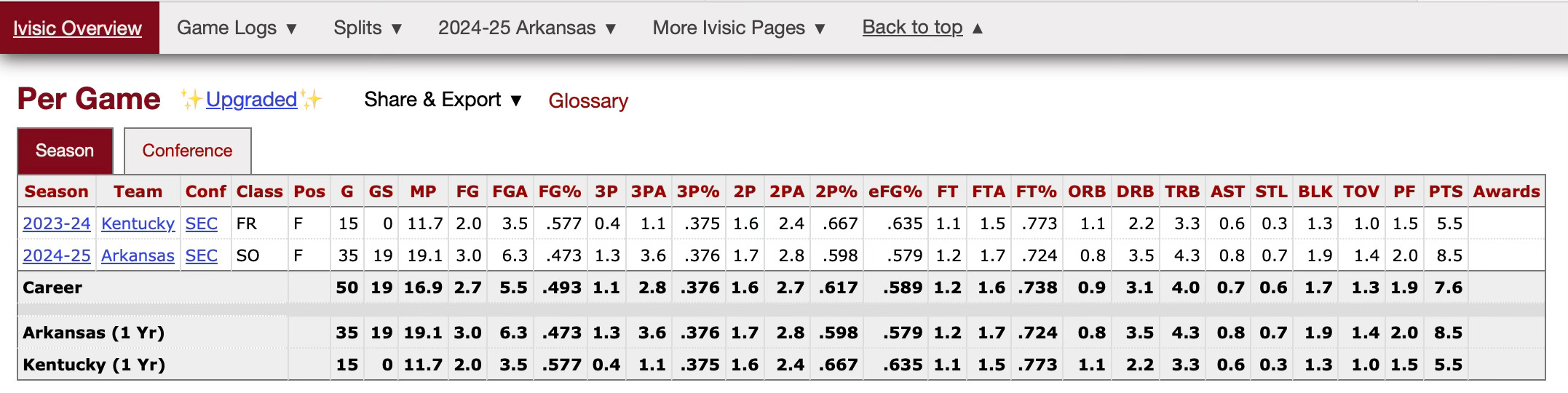
Similar to other international bigs, such as recent Stanford grad Maxime Raynaud (#42 Overall Pick), who had experience in France’s top league, the transition into college basketball did not come with immediate impact for Ivsic.

Vastly improved 3-point splits for Ivisic indicate that a similar development path to Raynaud (above) could position him for a breakout season with the Illini, with a real ability to stretch the floor.
The last of the Adriatic Illini, Mihailo Petrovic, arrives from KK Mega, a Serbian club that takes a unique approach to roster-building. Mega fills its lineup with teenagers and early twenty-somethings, then allows them to play big minutes without the presence of older veterans. Mega’s youngsters are showcased precisely because they’re tested against some of the best professional talent outside the NBA, and they have developed a pipeline because of it. Since 2014, they have had 16 players drafted into the NBA.
Mihalio Petrovic (PG): 2 years in ABA competition

Petrovic is by far the most day-one-ready prospect. Aligning with the ideology of KK Mega, Petrovic was given the keys as the starting point guard and was able to both facilitate and score efficiently in a challenging league. Petrovic will enter college accustomed to being a high-volume player in a highly competitive league. With improved 3-point shooting, he could be as deadly as they come in the Big 10.
The international trend will not slow down. As long as the NCAA continues to grant eligibility to these players, college programs will increasingly poach talent from overseas. Two days ago, Oregon announced the commitment of Chinese Basketball Association standout Wei Lin, who averaged 21 points, 3.3 rebounds, and 5.0 assists in 34.1 minutes last season.
Are players with the pedigree of a Wei Lin, Mihalio Petrovic, or Thijs De Ridder expensive? Absolutely, just like a high-major transfer, they are proven. Like most players with high market value, they are often “money hunting,” which does not provide much security to a program looking for a multi-year investment. As a one-year rental to get over the hump, however, they certainly feel like some of the most sure-fire bets a team could make.
III. How Good is Darlan?
We’ve talked plenty about the influx of international professionals into college basketball, but how does that compare to our subject at hand — domestic pro Thierry Darlan?
Stylistically, the G League is different. Playstyle mirrors the NBA with more possessions, a faster pace, and an emphasis on spacing, pick-and-rolls, and isolation creation. Last year, Darlan held his own in the G League’s open style, averaging 10.9 points, 6 rebounds, and 2 assists in just under 26 minutes for the Delaware Blue Coats.
This season, he’ll be tasked with translating that skill set into a college system as he suits up for the Santa Clara Broncos of the West Coast Conference.

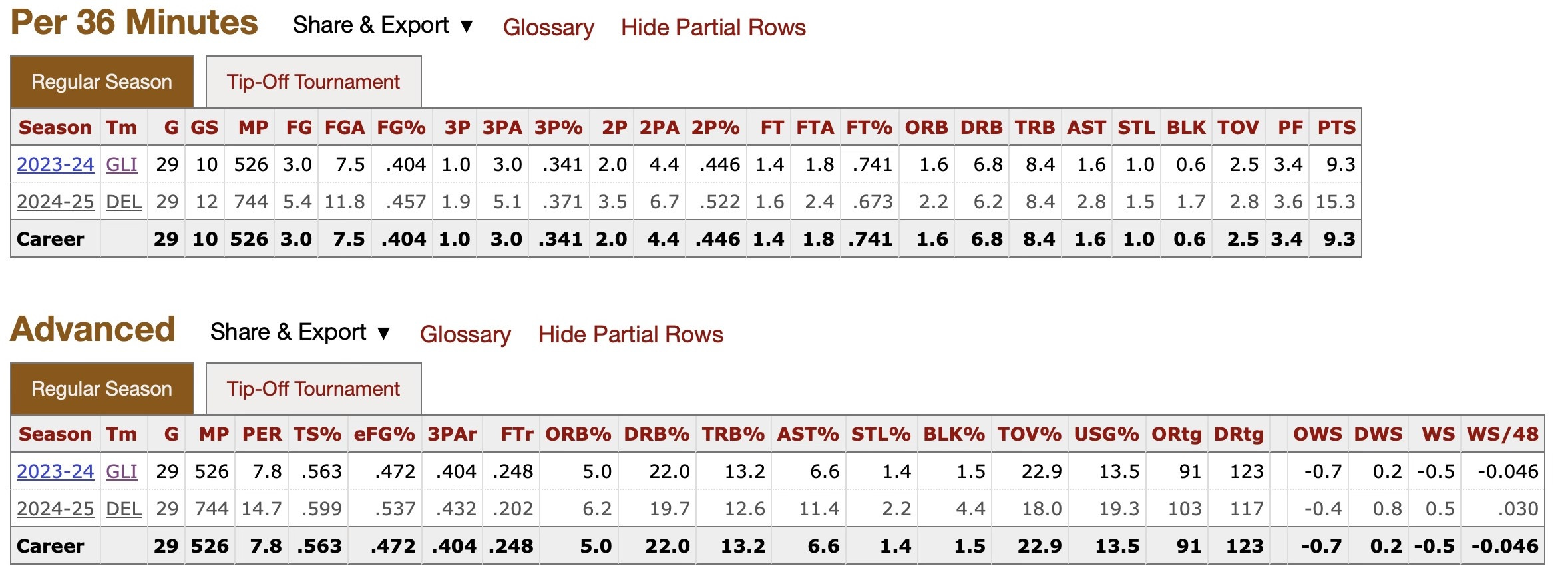
In his sophomore G League campaign, Darlan proved to be a formidable three-point threat (from 23’ 9”) and a net positive on defense. With his size and length, he is a 3 and D player that will likely be a matchup nightmare on both ends in the WCC.
Without Darlan added to the roster, Barttorvik has Santa Clara positioned 91st in the country and 4th in a top-heavy WCC behind Gonzaga (24), Saint Mary’s (54), and San Francisco (59). With his addition, they should likely make a big leap towards the top of the preseason predictions.
Much like the international prospects, Darlan has proven he can produce, even at a replacement level, in higher-level competition than the WCC. Darlan will likely be tasked with shouldering a bigger load at Santa Clara, and, if he can maintain his efficiency against less size and talent, his ceiling is high.
You probably don’t read my blog for my in-depth player analysis. I would say that is wise; however, for your benefit I have asked my network of basketball minds (coaches, college GMs, pro-front office) how they project Darlan. Everyone acknowledged the potential for Darlan to be a solid player in the WCC, but just how good ranged widely.
Ultimately, it depends on the role and usage, but a sizable minority of those asked were confident that he would become a first-team all-conference player. Those who were most bullish on the certainty of his impact even positioned Darlan as someone whose ceiling is a 20/10 player.
However, many felt that Darlan’s production was more of an unknown. Most people believe he will be an all-conference talent, but are unsure whether that will be on the 1st, 2nd, or 3rd team.
Compared to Euro circuits, many noted that the G League is both a step down and has inflated statistics due to high possession rates, weaker defensive output, and longer games. The majority consensus is that his production in basic counting stats may only see a slight uptick from what he has shown in the G League.
Some cited a lack of development in the G League towards becoming a legitimate NBA prospect and a decision to play in the WCC rather than a blue-blood program as red flags.
It appears as though the jury is still out on how well Darlan’s skill set will translate to the college game; however, if anyone knows how to get the most out of a two-way wing guard, it is Herb Sendek. Compared to recent contemporaries at Santa Clara, most did not find Darlan to have the game right now to put up similar production to Jalen Williams or Brandin Podziemski, who each received first-team all-WCC accolades.
However, this is a novel situation. Unlike Williams, a three-year player who developed under Sendek, or Podziemski, a four-star transfer product, Darlan has already produced at a high level of competition. How much that experience translates into Sendek’s “pro-style” system will be a very interesting case study that college basketball has yet to see.

Noah Henderson is the Director of the Sport Management Program and a Clinical Instructor at Loyola University Chicago’s Quinlan School of Business. His work explores the intersection of law, economics, and the social consequences of college athletics, particularly in the areas of name, image, and likeness (NIL), athlete labor rights, and sports gambling.
Henderson helped amend Illinois’ NIL legislation and played a direct role in establishing early frameworks that facilitated the legal payment of college athletes at Student Athlete NIL. He continues to advise athletic departments, brands, and sports agents nationwide on NIL policy, legal compliance, and best practices.
He contributed extensively to Sports Illustrated’s NIL Daily, where his reporting and commentary helped shape public understanding of the evolving business of college athletics. His insights have been featured by ESPN, NPR, CNN, PBS, Sportico, the Chicago Tribune, and others.
Henderson holds a Juris Doctor from the University of Illinois College of Law and a degree in Economics from Saint Joseph’s University, where he was a four-year letter winner on the golf team.